What Small Businesses Need to Know About AI Search, Brand Clarity and Building for What's Next
There comes a moment in most business conversations about marketing when someone says something that reframes everything. For us, it happened when we started asking a simple question: what is AI actually saying about UpHouse? Not what we wanted it to say or what our website said.
We asked what AI—ChatGPT, Perplexity and Gemini—was actually pulling together and telling people when they asked about marketing agencies. The answer was humbling and it led us to build something new.
We recently sat down with the Canadian SME Small Business Podcast to talk through what we've learned about distributed brands, AI search visibility, marketing clarity and the real work behind building a values-driven business.
Below are the ideas from that conversation that we keep coming back to.
The Distributed Brand: Your Brand No Longer Lives in One Place
The first shift worth naming is that reputation is no longer centralized. It does not live on your website or your social media feed. It lives across every surface where people encounter you, including search results, reviews, employee posts, media mentions, community conversations and increasingly, AI-generated summaries that pull all of those signals together into a single answer.
That is what we mean by a distributed brand, and it changes what good marketing looks like.
When your brand is distributed, the most important things you can do are not about volume. They are about clarity. This means making what you do easy to understand, using consistent descriptions across your website, directories, Google Business profile and social channels and collecting proof, reviews, case studies and third-party mentions, because that external validation is what both customers and AI tools trust most.
A distributed brand is not about becoming louder. It is about showing up clearly, wherever people, and now AI, are looking for you.
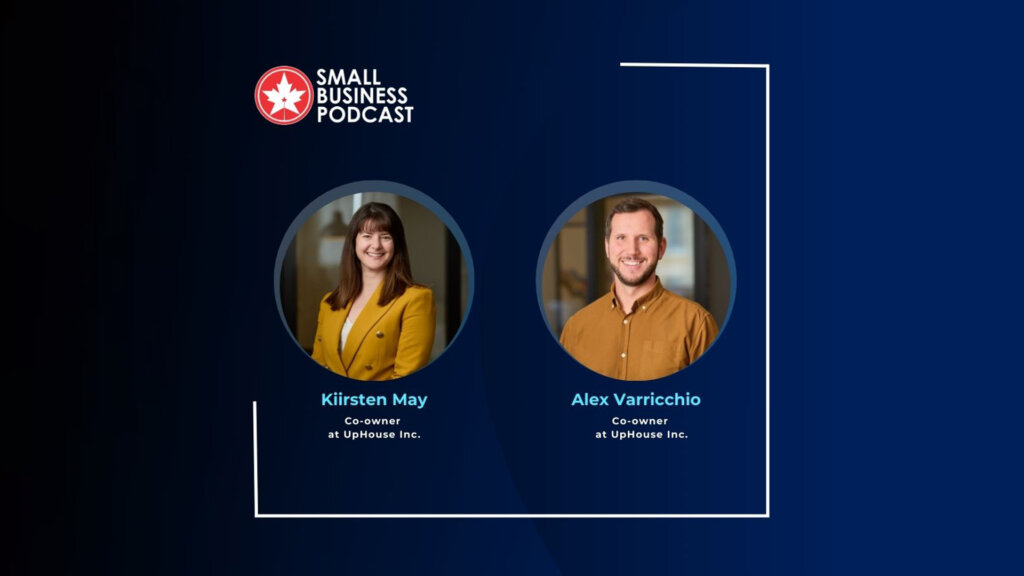
smbpodcast.ca feature images – Kiirsten May
AI Search Visibility: We Have Moved from an Era of Search to an Era of Ask
AI has changed faster than most of us expected. In a survey we ran this year, AI has now surpassed Google as the source people find most helpful: 33% of respondents named AI search as their top resource, 70% of holiday shoppers said they used AI tools in their decision making and 47% said they made at least one purchase with the help of AI. That is not a slow shift but a strikingly fast one.
What it means practically is that people are no longer typing short keywords into a search bar. They are asking full questions, the way they would ask a knowledgeable friend, and they expect a real answer in return.
For small businesses, this creates both a challenge and a window. Only about 10% of organizations have an actual strategy for AI search. That means the space is still open. The brands that move now, that get clear on their positioning, add natural Q&A language to their websites, build consistent information across platforms and earn external mentions, are going to have a real advantage. There is no one who owns this space yet, and that is a gift if you use it.
Marketing Clarity Is the New Superpower
In a world of exponential content growth, the businesses that win are not the ones producing the most. They are the ones that are the clearest.
One framework we come back to often is the positioning ladder. Imagine a ladder representing your product or service category. The rungs are the best-known brands in your space, each one occupying a distinct position in the minds of your customers. Maybe one brand wins on convenience, another on price and another on values.
When you are a smaller brand trying to stand out, you have two choices. You can try to knock someone off an existing rung, which usually means outspending them. Or you can create a new rung entirely, one that no one else is occupying yet.
That second option is where most small businesses actually have a shot. And once you know your rung, the job is simple: get clear on it, say it consistently and say it everywhere.
The businesses that do this well, the ones that are specific about who they are and what they stand for, are the ones AI learns to recognize, reference and recommend.

Leadership Insight: Bring Outside Voices In
One of the ideas from our book, The Proximity Paradox, that keeps proving itself true is this: the people closest to a brand often have the hardest time seeing what makes it special.
We call it the Disruptor Brainstorm. The exercise is straightforward: invite three to six people who are not normally part of your marketing conversations—new hires, frontline staff, customers, critical friends—and ask them a simple prompt: if you were starting this business from scratch today, how would you attract customers?
Give it 30 minutes. Say yes to everything that comes up. Let the ideas flow without judgment. Then pick one thing you can execute quickly and actually launch it. The goal is not a perfect campaign. The goal is momentum, and a new angle you would not have found on your own.
And if you are willing to go further, to let customers tell your story through video or social content, that kind of authenticity builds trust in a way that polished brand messaging rarely does. People can see that you are willing to listen, experiment and evolve.
Values-Driven Impact: Purpose Has to be Verified, Not Just Claimed
UpHouse is a Certified B Corporation, and we recently completed our recertification, increasing our score from 95.5 points in 2022 to 130 points this year, out of a possible 200. What that process has taught us is that purpose cannot be a talking point. It has to show up in how you treat your workers, who you buy from, what you create and what you give.
As part of our B Corp work, we have committed to ramping up our pro bono services to 5% of staff time, giving our team's skills to organizations doing work that our people genuinely care about. We are not there yet. But we are building toward it intentionally, one project at a time.
The reason this matters for small businesses is not because every business needs to be a B Corp. It is because values have to be legible, in your actions, your choices, your consistency over time, for them to mean anything to customers or to AI systems trying to understand who you are.
Clear values, consistently lived, become one of the strongest brand signals you can build.

Go For It
If there is one thing we keep telling clients, our team and ourselves, it is this: brave ideas get noticed.
The shift happening right now in how businesses reach people is massive, and no one has fully figured it out yet. That means there is room, real room, for businesses of every size and background to get in, get clear and get their message out.
The more honestly you can tell your story, the more it will resonate. In AI search, in content, in every conversation you have with a customer.
So, get out there, be brave and get noticed.